Tank Level Measurement Using Pressure and Differential Pressure Transmitters
Pressure Switch Operation
September 30, 2018Installation and Configuration of Pressure and Differential Pressure Transmitters in Level Measurement
October 14, 2018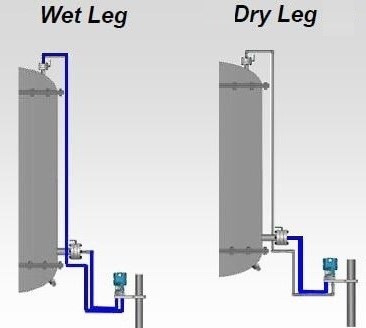
Tank Level Measurement Using Pressure and Differential Pressure Transmitters:
Level measurement by equating the pressure at the tank’s zero height point (MIN) is one of the indirect methods of level measurement.
As we know, the relationship between pressure and height is linear and is expressed using the formula P = ρ * g * h.
How to Extract Technical Data
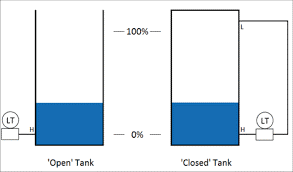
Tank Assessment in Terms of Open Tank (Atmospheric) or Closed Tank (Pressurized) :
If the tank is open and the pressure at its surface is atmospheric, a Pressure Transmitter (PT) can be used to measure the tank level.
It is also possible to use a Differential Pressure Transmitter (DPT), where the Low input of the transmitter is open to atmospheric pressure. However, this approach is not economically optimal.
For measuring liquid levels in closed and pressurized tanks, pressure transmitters cannot be used due to the presence of gas pressure above the liquid.
Because the gas pressure above the liquid combines with the hydrostatic pressure from the liquid column and is measured by the PT.
In this case, differential pressure transmitters are used, with the Low input connected to the top of the tank and the High input connected to the bottom.
Since the DPT output represents the difference between the High and Low pressures, the measured value reflects only the hydrostatic pressure of the liquid.
Static Head :
At this stage, based on the tank height—or more precisely, the maximum design fluid level—and the fluid density, the static head is calculated.
(Possible temperature variations affecting fluid density should be considered.) Obviously, the PT or DPT used must be calibrated within this range.
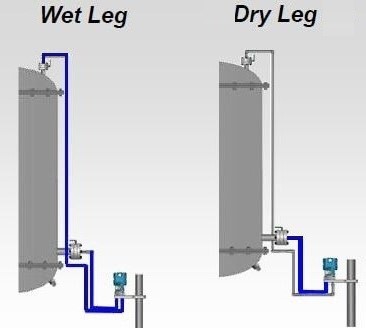
Connection PT یا DPT Tank Connection, Concept Overview Dry Leg – Wet leg – Suppression – Elevation :
The transmitter can be connected to the tank either directly or remotely (using tube, hose, or capillary).
Typically, the DPT is installed at the tank’s MIN height (zero measurement point), and the High input of the transmitter is connected directly to the fitting on the tank.
The MAX height connection on the tank is also linked to the Low input of the transmitter via a tube or capillary.
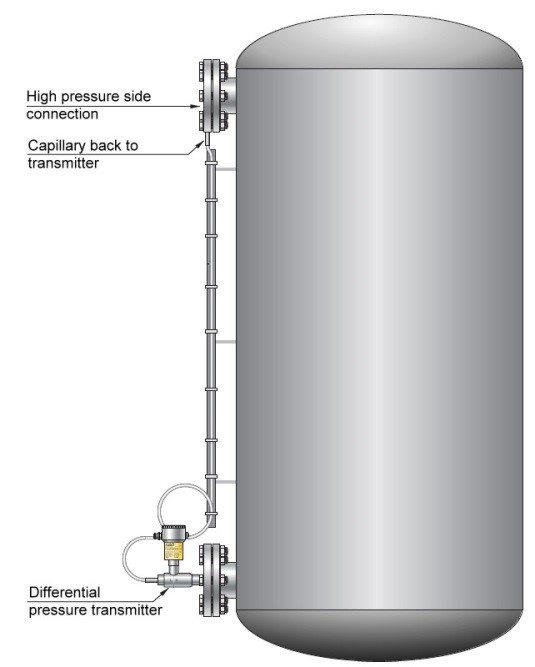
In a Dry Leg system, the gas above the liquid enters the intermediate tube directly, and its pressure is applied straight to the PT or DPT.
If the fluid is corrosive, viscous, or at high temperature, a Wet Leg system using oil should be employed.
This means that the Low port of the transmitter is connected to the tank via a diaphragm and capillary.
The capillary is filled with oil, which transmits the pressure. In this configuration, the instrument is isolated from the process.
Note that in a Wet Leg system, the fluid itself can also fill the intermediate tube connecting the top of the tank to the Low input.