Manifold Valve
Manifold Valves
Valves are among the most important components for controlling flow in industrial liquid systems. Under high-pressure conditions, they perform various functions to regulate pressure. Depending on their application, valves are designed with different configurations. Some of the most important types include:
Pneumatic check valves, high pressure needle valves, ball valves, toggle valves and purge valves
In the past, multiple devices had to be used for controlling two or more different flows. Installing two or more separate devices in the same location required significantly more space and resulted in higher costs.
Therefore, the use of a multi-purpose valve (Valve Manifold) solved this problem.
What is a Manifold Valve?
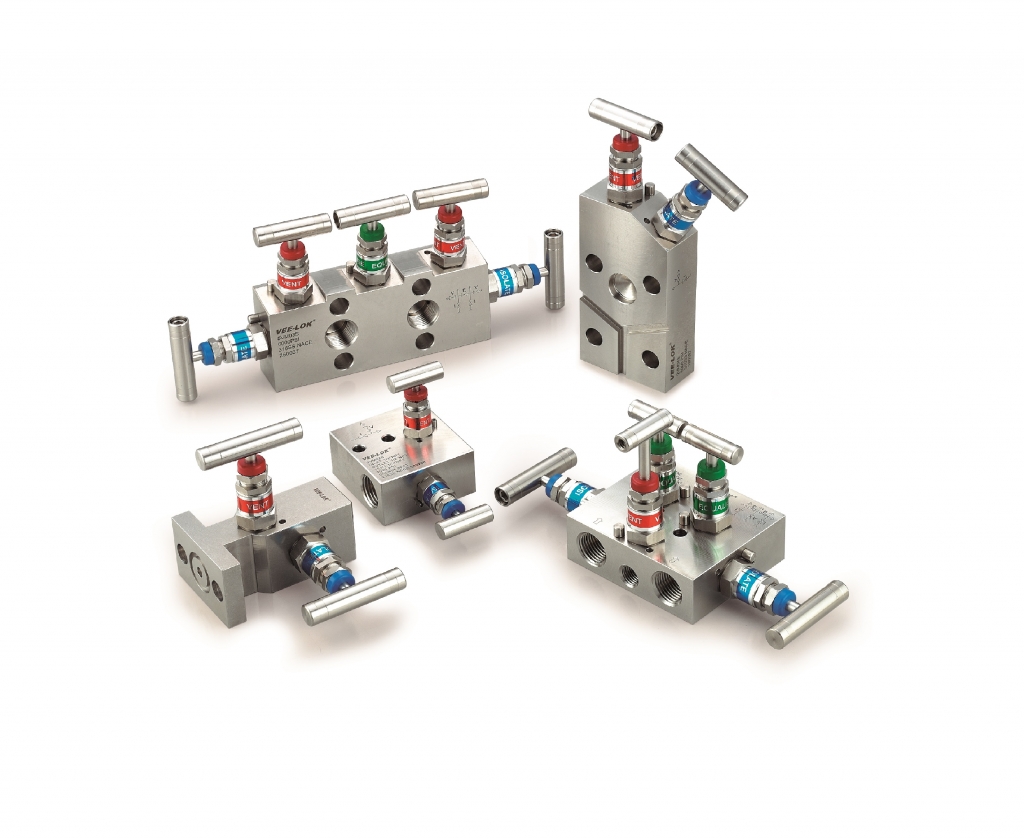
Manifold valves are devices in which two or more valves are interconnected to control a hydraulic system, providing standard access for pressure and differential pressure transmitters. By using a manifold valve alongside instrumentation equipment, maintenance or calibration can be carried out without shutting down the process line.
For such applications, manifold valves are generally available in three main types: two-way, three-way, and five-way.
Two-Way Manifold Valve
Primarily used for general plant services, standard pressure devices, differential pressure instruments, pressure measurement, and venting applications.
Two-way manifold valves are used with pressure transmitters. A typical manifold valve consists of a block valve and a test or drain valve. To use this valve for calibration, the block valve is closed, the drain is connected to a pressure source, and the pressure test is performed. This allows calibration without removing the instrument from the line or shutting down the process.
Three-Way Manifold Valve
Three-way manifold valves are used with differential pressure transmitters. This type of valve consists of two block valves and one equalizer valve.
To determine the zero point of a Differential Pressure Transmitter (DPT), simply close the block valves and open the equalizer valve. This equalizes the high- and low-pressure sides, and if the DPT is properly calibrated, it should indicate the zero point.
Five-Way Manifold Valve
Similar to three-way manifold valves, five-way manifold valves are used with differential pressure transmitters (DPTs). This type of valve includes two block valves, one equalizer valve, and two vent or test valves. The process for checking the transmitter’s zero point is the same as with a three-way manifold. For calibration, the transmitter can be tested at 3 or 5 points by equalizing the pressures and connecting the test valve to a pressure source.