Cold Welding
December 30, 2017Thermowell Construction
January 7, 2018
The Bourdon gauge operates on the principle that a flat tube, when subjected to pressure, tends to deform into a circular cross-section.
If the tube is shaped like aCor a spiral, applying pressure causes it to stretch, and the tube tends to straighten or unwind. This tendency is used to measure pressure through the resulting deformation. In 1849, this invention was patented by Eugène Bourdon in France. Due to its high sensitivity, linear performance, and accuracy, it is still widely used in pressure measurement today.
In 1852, Ashcroft purchased the Bourdon patent in the United States and became the largest manufacturer of pressure gauges. Additionally, in 1849, Bernhard Schäfer in Magdeburg, Germany, successfully patented the diaphragm pressure gauge, which, along with Bourdon gauges, revolutionized pressure measurement in industry. In 1875, after the Bourdon patent expired, Schäfer & Budenberg began producing Bourdon pressure gauges.
In practice, pressure measurement in Bourdon gauges is carried out using a closed-end tube with thin walls, whose open end is connected to a tube containing the fluid whose pressure is being measured. As the pressure increases, the closed end of the tube bends into an arc. This movement is transmitted through a linkage to rotate a gear, which is typically adjustable.
A small-diameter gear mounted on the pointer shaft amplifies the movement of the mechanism according to the ratio of the engaged gears. For the mechanism to accurately display pressure through adjustment and calibration, it is necessary to properly set the dial behind the pointer, adjust the position of the pointer shaft, and calibrate the length of the linkage.
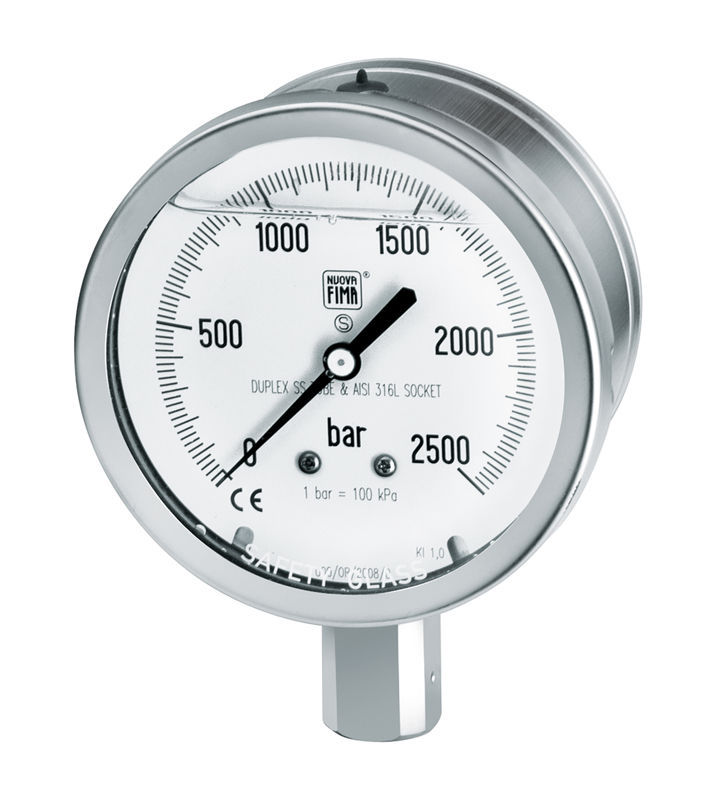
To measure differential pressure, a gauge with two Bourdon tubes properly connected can be used. Bourdon gauges measure pressure relative to atmospheric pressure, which is different from absolute pressure measured relative to a vacuum.
When the measured pressure fluctuates rapidly in pulses, a mechanical component with a restrictor hole is typically installed in the connecting tube between the measured pressure and the Bourdon gaugeThis prevents damage and wear to the gauge gears while simultaneously providing a reading of the average pressure.
When the entire gauge is exposed to mechanical vibrations, all internal components, including the pointer and the moving mechanism, are filled with oil or glycerin. High-quality pressure gauges can achieve accuracy up to 2% of the measuring range,while specialized gauges can maintain accuracy up to 0.1% of the maximum measurement value.