
Pressure Switch Operation
How can the flow rate of multiphase fluids be measured using an ultrasonic flow meter?
September 18, 2018
Tank Level Measurement Using Pressure and Differential Pressure Transmitters
October 2, 2018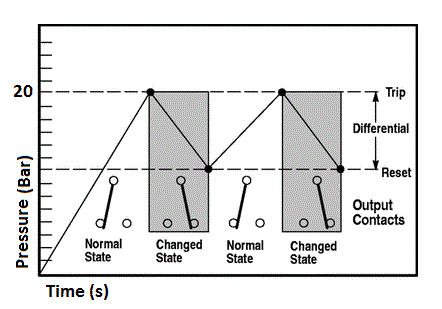
Pressure Switch Operation
Review of the concept Dead Band or differentialin pressure switches(Pressure Switch):
As you know, pressure switches are used to control pressure within a desired range in various processes.
The operation of pressure switches is such that when the line pressure reaches the desired set point, the switch is triggered, and the output signal changes state. Normally open (NO) contacts close, and normally closed (NC) contacts open.
Typically, the NC (normally closed) output of pressure switches is connected to pumps and compressors that provide pressure in hydraulic and pneumatic systems. When the system pressure reaches the set point, the contact opens, and the pump or compressor is disconnected and turned off.
An important point here is the reactivation time—when the switch closes again and the pump or compressor restarts after a possible pressure drop.

For better understanding, assume that in a pneumatic system, the air compressor is turned on and raises the system pressure to the desired level of 20 bar. Then, with the operation of the pressure switch, the pump supply is cut off and removed from the circuit.
After using the system's compressed air as the driving force in pneumatic cylinders, the pressure drops below 20 bar.
The question that arises now is at what pressure the switch should be reactivated (reset) to turn the compressor back on—19.9 bar, 18 bar, or another value. The answer to this question, or in other words the necessity of defining this range, inevitably leads us to introduce a new conceptual definition.
Differential or Dead Band refers to the difference between the two aforementioned values. It indicates the pressure change required after the pressure switch operates at the set point for the contacts to return to their original state, the switch to reset, and the compressor to restart.
In other words, the Dead Band or Differential refers to the pressure range that starts from the set point on one end and extends to the minimum operating pressure of the system, within which the system should always operate. This value is expressed as a percentage of the range.
The width of this range depends on the minimum pressure required to meet the needs of the pneumatic system.
It is important to note, however, that the wider this range is, the less frequent the switch operations and, consequently, the fewer the on/off cycles of the compressor. This reduces mechanical stress and system wear, thereby increasing its service life.
For example, if we consider the Dead Band in the above example to be 0.1 bar, as the system pressure drops from 20 bar to 19.9 bar in a fraction of a minute, the compressor will turn on again. After a few seconds of operation, the pressure reaches 20 bar, and the pump shuts off again.
This cycle would continue repeatedly, leading to damage to the compressor, pressure switch, and other system components.
Therefore, selecting an appropriate Dead Band for pressure switches in pneumatic and hydraulic systems is crucial for maintaining stability and prolonging the lifespan of the system’s components and equipment.
The NO (normally open) output of pressure switches is usually connected to alarms and solenoid valves.
In this way, when the process pressure reaches the upper set limit, the contact closes, activating the alarm (signal lamp or buzzer) to notify the user. At the same time, the solenoid valve opens, allowing the fluid at the desired pressure and flow rate to be used in the process.

In the selection and ordering of pressure switches, the following important factors must be taken into consideration:
Operating range depending on the process pressure variations (Minimum – Operating – Maximum – Design)
Material of wetted parts and insulation depending on the type of process fluid and operating temperature
Wetted Parts Materials: Brass, Stainless Steel, Monel, Hastelloy, Duplex, …
Sealing Materials: NBR, FKM, VITON, PTFE, …
The type and size of the process connection to the pipe or vessel (Flanges – Threads).
Housing material and protection degree (IP), which are determined based on the environmental conditions of the installation site.
Type and specifications of output contacts
Contact Type: Micro switch, Magnetic, Reed, Electronic, …
Contact Rating: Rated Voltage and Current
Fixed or adjustable differential (Dead Band)

