Temperature Sensor
November 18, 2018Fieldbus Protocol
December 10, 2018
Review and Comparison of Protocols HART and Fieldbus in industry
Industrial protocols are used to connect different parts of an industrial system, including field instruments, control systems (PLC-DCS), actuators, and other components of industrial automation systems.
Industrial protocols are essentially rules and standards that enable communication between industrial equipment using analog and digital signals.
Protocol HART :
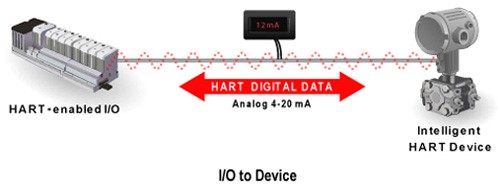
One of the most common industrial protocols in our country is the HART protocol. HART stands for Highway Addressable Remote Transducer, which means creating addressable (distinct) paths between field transducers (transmitters) and the control system.
The operation mechanism of this protocol works as follows: in addition to transmitting field information (temperature, pressure, weight, flow, vibration, speed, humidity, level, etc.) via a pair of wires with DC voltage and a 4-20 mA analog current, a digital signal with an amplitude of 0.5 mA is superimposed on the analog signal at frequencies of 1200 Hz (digital one) and 2200 Hz (digital zero).
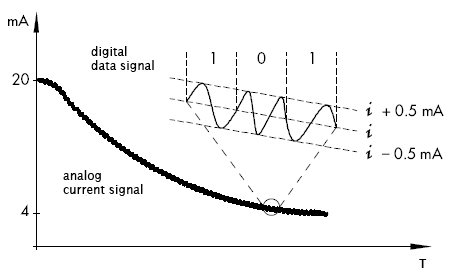
This digital signal transmits secondary information, including equipment specifications, calibration data, configuration, potential errors, and more. Establishing this communication path between field components and the control system significantly increases stability and reduces the need for user intervention.
Digital communications in the HART protocol are of the Request/Reply type.
In this case, the central control system periodically requests the required information from the field and, if necessary, makes changes to the configuration and calibration of the transmitters in the field. A maximum of 15 field devices can communicate under the HART protocol, provided that the connection is of the multi-drop type.
One of the most notable advantages of the HART protocol is its ability to be gradually expanded and individually connected to existing automation systems that operate using the standard 4-20 mA analog industrial signal.
In this case, digital data can be transmitted over the pre-existing pair of wires, eliminating the need to modify the wiring.