
Vortex Flow Meter
Applications of Differential Pressure Gauges in Industrial Processes (2)
June 1, 2020
Review and Comparison of Orifice and Venturi Flow Meters
June 28, 2020
Vortex Flow Meter (VORTEX)
As we know, the measurement of fluid flow rate in industry occurs continuously. Since the characteristics of the fluids and processes, such as density, viscosity, temperature, pressure, and line size, vary, using appropriate and compatible measurement mechanisms is essential. Additionally, the required accuracy and cost-effectiveness of purchasing a flow meter further emphasize the importance of understanding and correctly selecting the suitable mechanism.
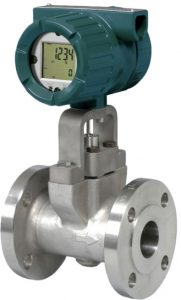
Vortex flow meters are a well-known type of flow meter used in various industries. The operating principle of vortex flow meters is based on generating vortex flows by placing a bluff body in the fluid path. This bluff body can have different geometric shapes, but generally, one side is wider while the opposite side is narrower. The direction of fluid flow in vortex flow meters is crucial, as optimal vortex waves are generated when the fluid strikes the wider side. The generated vortices then immediately impact a magnetic or capacitive sensor located behind the bluff body. This sensor counts the number of vortex hits per unit of time (frequency) to measure the fluid flow velocity.
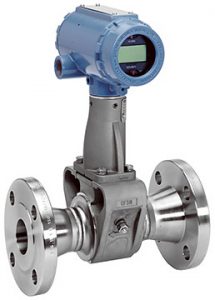
Vortex flow meters are not an ideal option for liquids, as the vortices generated in liquids have much lower amplitude compared to gases and steam, resulting in reduced measurement range and accuracy—especially when the liquid viscosity is high.
Additionally, if the process generally operates at low pressure and low velocity, the use of a vortex flow meter is not recommended, as optimal vortices necessary for accurate measurement may not be generated in such conditions.
شرکت ایساتیس فرآیند ابزار آمادگی خود را جهت تامین ادوات ابزاردقیق بصورت تحویل فوری و سفارشی اعلام می دارد.
To request the catalog Click here to download the NuovaFima product catalog.

