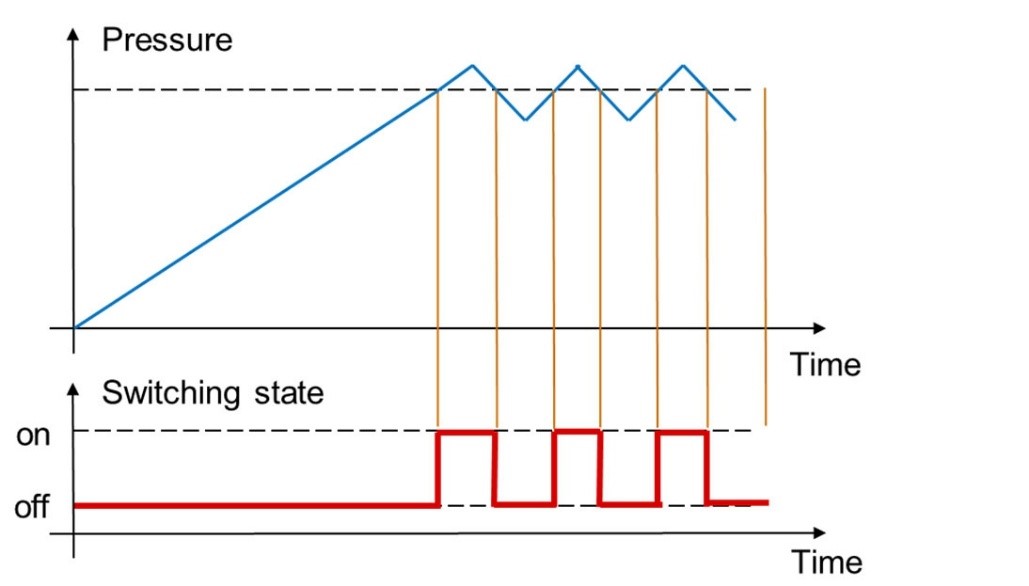
Hysteresis Switching Function with an Electronic Pressure Switch
May 13, 2018General Specifications of Instrumentation Equipment
May 27, 2018
General Specifications of Process Measurement Equipment (Instrumentation)
One of the most important considerations in many industries, including petrochemical, refinery, power plants, steel, pharmaceutical, and food and hygiene sectors, is the monitoring and control of process conditions (such as temperature, pressure, level, flow, weight, humidity, etc.). These measurements are made possible through instrumentation devices.
For reliable and acceptable measurements, the characteristics of the measuring instrument must be compared with the required technical expectations. The following sections review these features in detail.
Measurement Range :
The measurement range is the span of values of a quantity that the measuring element is capable of detecting. It is important to select a measurement range larger than the expected variations of the quantity being measured.
Accuracy :
Accuracy refers to the difference between the value measured by the instrument and the true value of the quantity being measured. It is usually expressed as a percentage of the full-scale value (FSV).
Precision :
Precision refers to the level of detail and fineness in displaying the measured value. For example, an instrument that shows a measured pressure of 8.1 bar is less precise than one that displays the same pressure as 8.135 bar.
Repeatability :
Repeatability in measurement refers to the closeness of output values (measured readings) for a constant input over short time intervals. In other words, an instrument that measures a constant process pressure (e.g., 1 bar) as 1 bar at one moment and 1.1 bar at another is not ideally repeatable.
Linearity :
If the relationship between the input changes and the output changes of a measuring device is proportional, the device is considered linear. For example, if a pressure instrument shows 2.02 bar for an actual pressure of 2 bar and 4.04 bar for an actual pressure of 4 bar, it operates in a perfectly linear manner and has an ideal linear characteristic within that range.
This property is also defined as sensitivity and is expressed as the change in the instrument’s output per unit change in the measured quantity, or as the slope of the sensor’s characteristic curve.
Measurement Zero :
A specific point within the measurement range is usually defined as the zero point. For example, in temperature measurement, the zero point is the temperature at which water freezes, while in pressure measurement, atmospheric pressure is considered as zero. However, at the zero point, the instrument’s output is not necessarily zero and may have a certain value.
Zero Drift – Offset :
Measuring instruments are usually adjusted so that the output at zero input equals zero (or another specified value). However, over time or due to other factors, the output at the zero point may change. This phenomenon is called zero drift and can lead to significant errors in the control loop.
Zero Drift is divided into two categories:
This drift is caused by external and environmental factors such as temperature or power supply variations.
This drift is caused by wear or changes in the properties of the measuring element over time.
Response Time:
Response time is the duration between a change in the measured quantity (input) and the moment this change is reflected by the instrument (output). A good instrument should measure the quantity quickly. In practice, however, instruments have a time constant and sometimes a delay, so that if the input changes suddenly (step input), the output display will respond with a delay.
Hysteresis :
Hysteresis is a type of nonlinear behavior in measurements. It can be defined as the phenomenon where the output differs when the measured quantity approaches the same value from higher versus lower values.
For example, if a process pressure reaches 5 bar once from 10 bar and another time from 1 bar, and the instrument displays 4.8 bar in the first case and 5.2 bar in the second, hysteresis is present.
Hysteresis occurs due to the non-elastic properties of the measuring system or instrument components. For instance, backlash in the gears of instrumentation devices can cause hysteresis.