
Electromagnetic Flowmeter

Fieldbus and HART
June 18, 2017
Vortex Flow Meter
July 8, 2017Electromagnetic Flowmeters
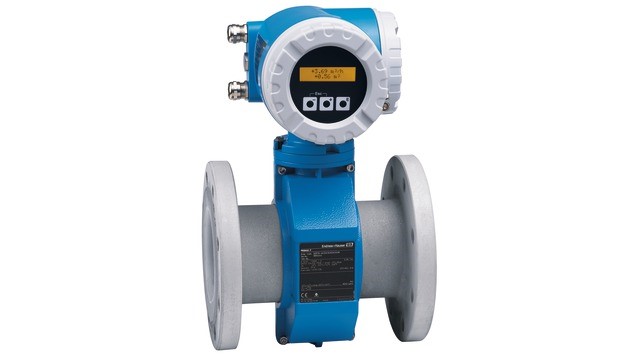
Electromagnetic flowmeters operate based on Faraday's law of electromagnetic induction. Naturally, the fluid must have a minimum conductivity to allow current flow and generate magnetic flux (approximately 10 µ S/cm). Electromagnetic flowmeters typically operate at temperatures up to 260°C, and depending on the liner inside the flowmeter, they are manufactured from materials such as PTFE (Teflon) or hard rubber for different applications.
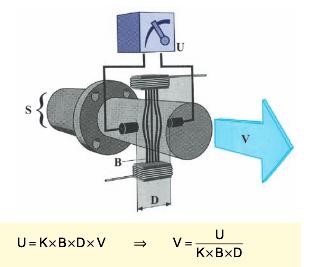
In the figure above, U represents the voltage induced by the movement of the fluid in the magnetic field B, which is proportional to the distance between the electrodes D, the fluid velocity V, and the constant K.
Applications of Magnetic Flowmeters:
Water and wastewater treatment facilities, dam outlets, wells, pumping stations, and urban and rural water supply pipelines.
Chemical industries, acids, caustic soda, caustic solutions, adhesives.
Food industry, mineral water, milk, yogurt, doogh, molasses, sugar beet syrup.
Pharmaceutical Industry
Metal / Mining Industries
Paper / Pulp Industries
Marine Industry
Water Pipeline Networks / Water Management
Agricultural Irrigation
Water Measurement / Water Trading
The advantages of using an electromagnetic flowmeter include having no moving parts (resulting in minimal mechanical wear). The pressure drop caused by fluid flow is nearly equal to that in a pipe of the same diameter without a flowmeter. Energy consumption is relatively low, with some models requiring less than 20 watts. These flowmeters are mechanically non-restrictive and can be equipped with wear-resistant linings, making them effective for measuring abrasive fluids. They offer a very wide measurement range, capable of accurately measuring very low to very high flow rates, with a minimum diameter of approximately 0.125 inches and a maximum flow volume up to 10 cubic feet.
Despite these advantages, electromagnetic flowmeters also have specific limitations. They are effective only on electrically conductive liquids and cannot measure fluids such as hydrocarbons or non-conductive gases. Additionally, magnetic materials within the fluid can cause issues, as hydrodynamic effects may alter the natural flow profile, reducing the velocity enough to generate the required induced voltage. Due to their size and capacity, electromagnetic flowmeters can be relatively heavy, and models with higher resistance to corrosion and wear tend to be more expensive.
When installing this type of flowmeter, certain important considerations must always be taken into account, which are outlined as follows: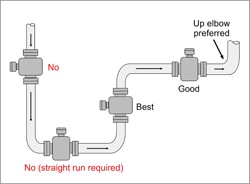
An electromagnetic flowmeter must always be installed in the pipeline so that it remains fully filled with liquid. The piping configuration should prevent the formation or accumulation of any secondary phase (solids or air). In very specific cases, electromagnetic flowmeters can be installed in horizontal lines, but the best practice is to install them in vertical lines with the flow direction going upward.
Mechanical vibrations can damage the electrode system and transmitter. Therefore, these flowmeters should be installed in areas with minimal vibration.

