
Pitot Tube
Orifice Plate Software
November 5, 2016
Differential Pressure Level Meter
November 5, 2016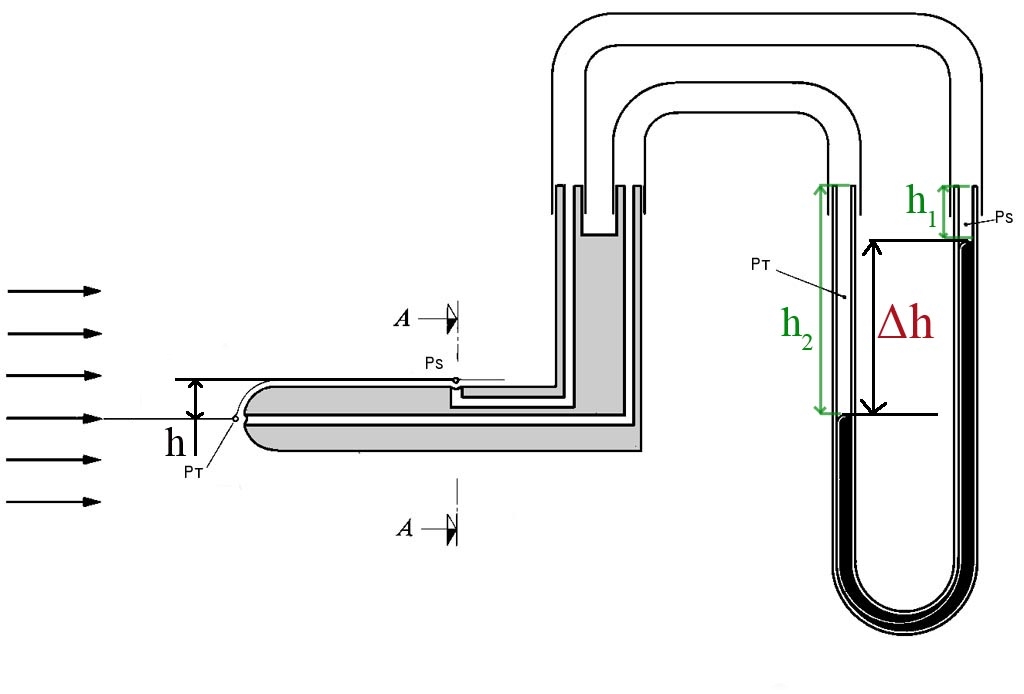

Pitot Tube
The Pitot tube is one of the most accurate methods for measuring velocity. Pitot tubes are used to measure local fluid velocity and pressure. They are also employed to determine fluid flow rates for experiments, research studies, and similar applications. A specific type of Pitot tube is used to measure airspeed in aircraft.
Essentially, a Pitot tube measures velocity and flow rate by determining the difference between the total pressure (or impact pressure) and the static pressure. This pressure difference, known as the kinetic pressure, is related to velocity through a relationship derived from Bernoulli’s principle. Therefore, to determine the dynamic (kinetic) pressure and, consequently, the velocity at a specific point in the fluid flow, it is necessary to measure the difference between the static pressure and the total (impact) pressure. The total pressure is measured using a pressure tube, which is installed so that its opening faces the fluid flow. The static pressure is measured through one or more ports provided in the wall of the flow passage.
Since the fluid velocity at a specific point is determined using the pressure difference (Pt − Ps), the heads of the total and static pressure sensing tubes must be connected to a low-pressure liquid column or a differential manometer.
The increase in the liquid level is determined by the force exerted by the fluid.

