HART Protocol
November 26, 2018Instrumentation Valve
December 17, 2018
Protocol Fieldbus :
The biggest limitation of analog systems with a 4-20 mA industrial signal is their point-to-point nature.
This means that each field device requires a dedicated I/O port on the control system, as well as a separate pair of wires between the transmitter and the PLC, which can only transmit the temperature or pressure of a single point in the field.
Even when using the HART protocol with a multi-drop topology, a maximum of 15 devices can be connected in parallel to a single channel, and in this case, the network speed is significantly reduced.
To address this limitation, the Fieldbus theory was introduced. In this protocol, a single bus exists to which all devices are connected, allowing data exchange at any time. Essentially, this bus acts as a node that links all field components to each other and to the control system. In Fieldbus technology, communication between all devices is fully digital and bidirectional.
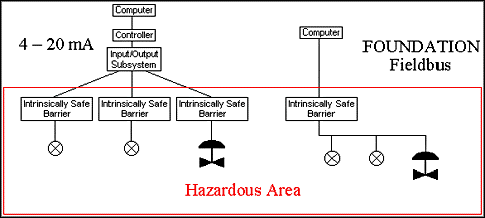
If we want to connect an old automation system that uses 4-20 mA signals or even 3-15 psi pneumatic systems to a Fieldbus-based system, or fully modernize it, A/D converters can be used. These act as an interface, converting analog signals into digital signals compatible with the Fieldbus protocol.
The main obstacle to using Fieldbus as a modern, fully digital protocol with high speed, safety, and savings in wiring, barriers, and electrical panels is the high cost of replacing existing analog systems, as well as the widespread adoption of the HART protocol in developing countries.
It is important to note that in less complex systems with a low number of I/Os, using analog signal-based protocols is more economically efficient.